Landlord-Tenant Rights and Responsibilities (Rio del Mar, Unincorporated Aptos)
Rights and responsibilities for renting a single-family home to Jai’s 4-person cohort at 613, Rio del Mar (unincorporated Aptos, Santa Cruz County). Three layers: California statewide law (the floor), the unincorporated-county local rules, and the lease mechanics (disclosures, co-tenancy, insurance). Not legal advice — have a California landlord-tenant attorney review the final lease packet.
Bottom line for the cohort
- No local rent control and no local just-cause in unincorporated Santa Cruz County — the only rent cap / just-cause is state AB 1482, and a single-family home escapes even that if the owner is not a corporation and the verbatim exemption notice is in the lease.
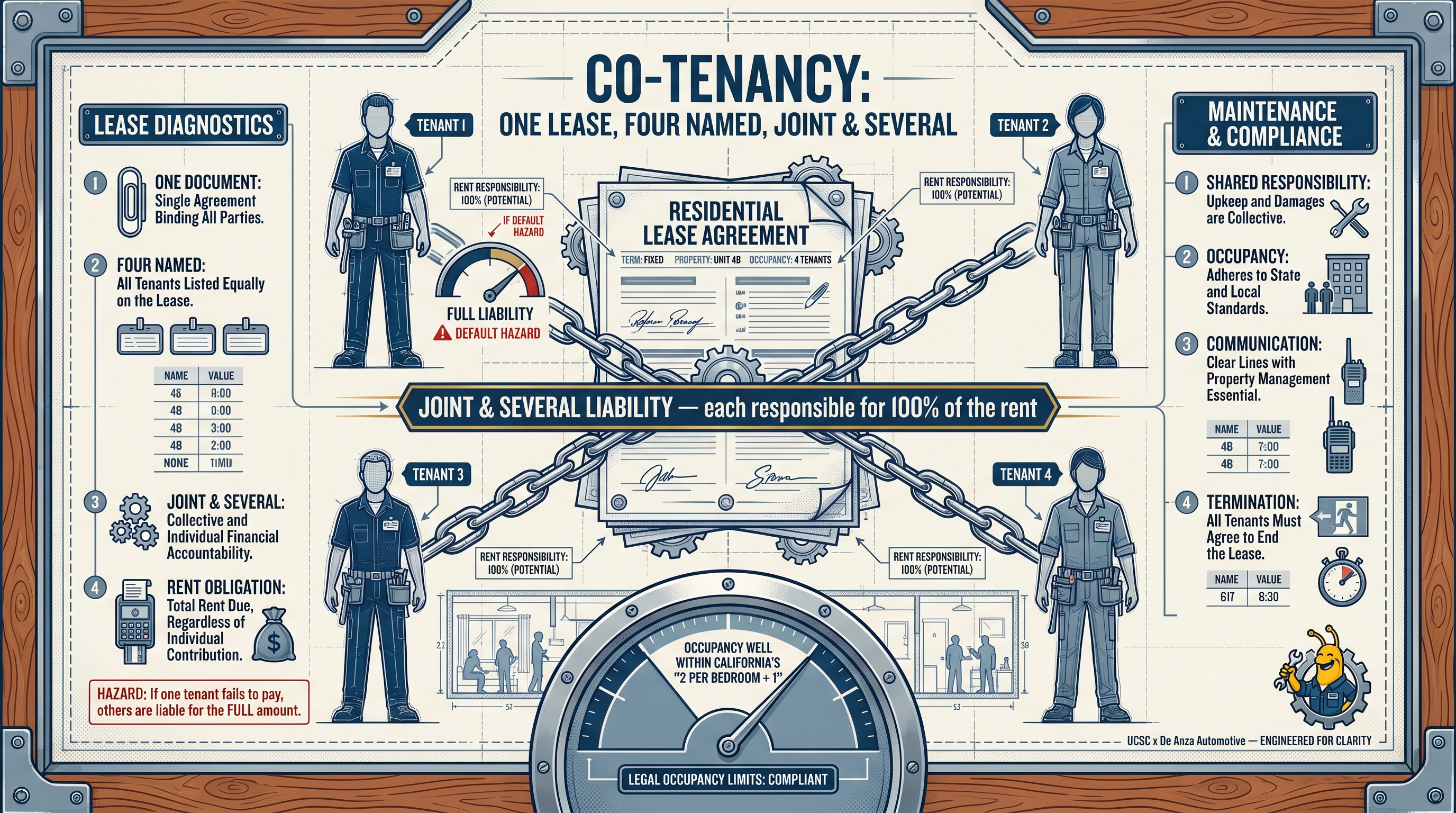
- Structure: one lease, all four named, joint-and-several liability. Occupancy (4 people) is well within California’s “2 per bedroom + 1.”
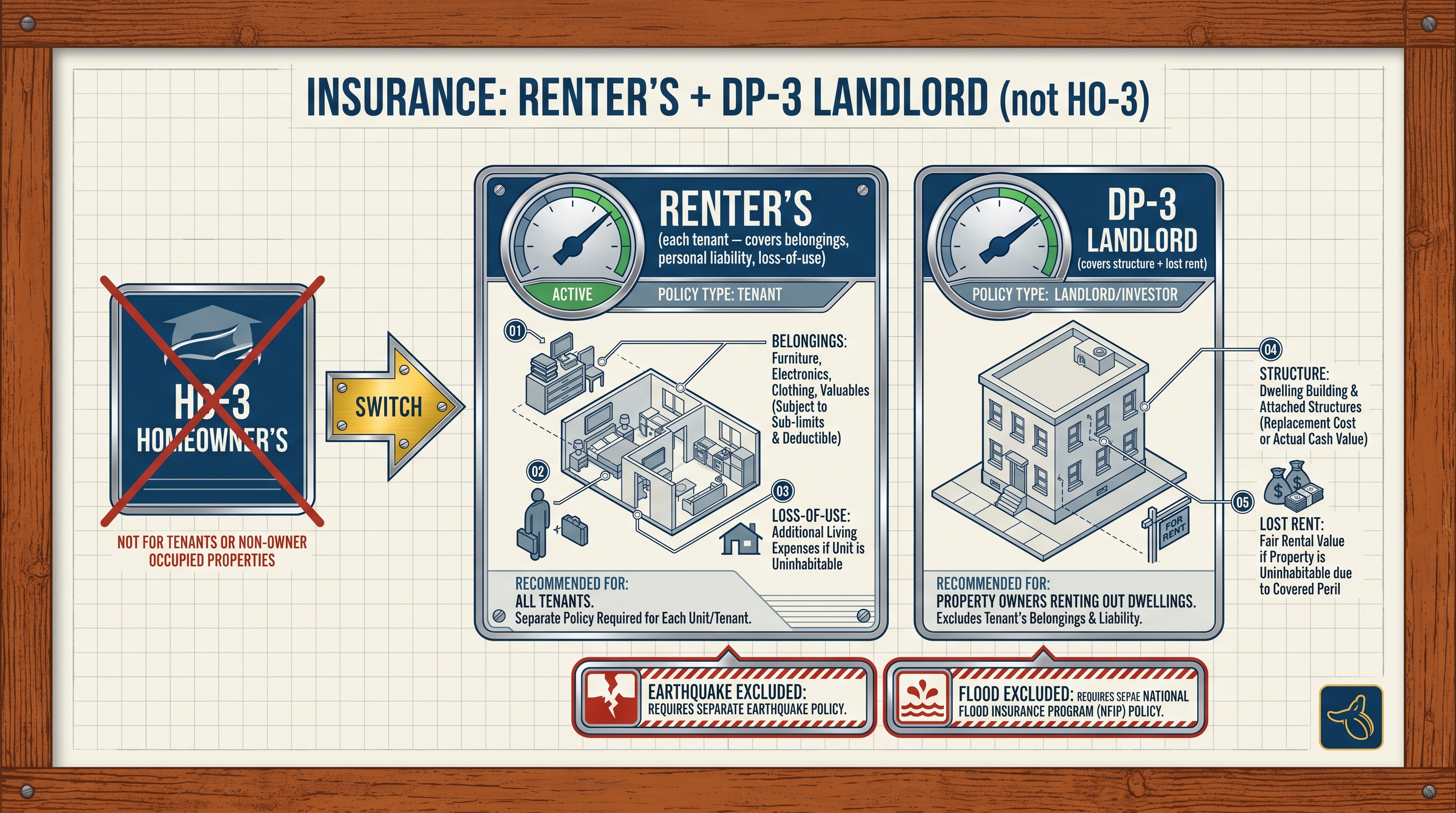
- Require renter’s insurance (lawful, cheap); Ian must switch his own policy from HO-3 to a DP-3 landlord policy.
- Rio del Mar is a FEMA flood zone (AE) at Aptos Creek — flood disclosure is required and flood insurance is likely needed; earthquake is excluded from standard policies (Santa Cruz seismic zone).
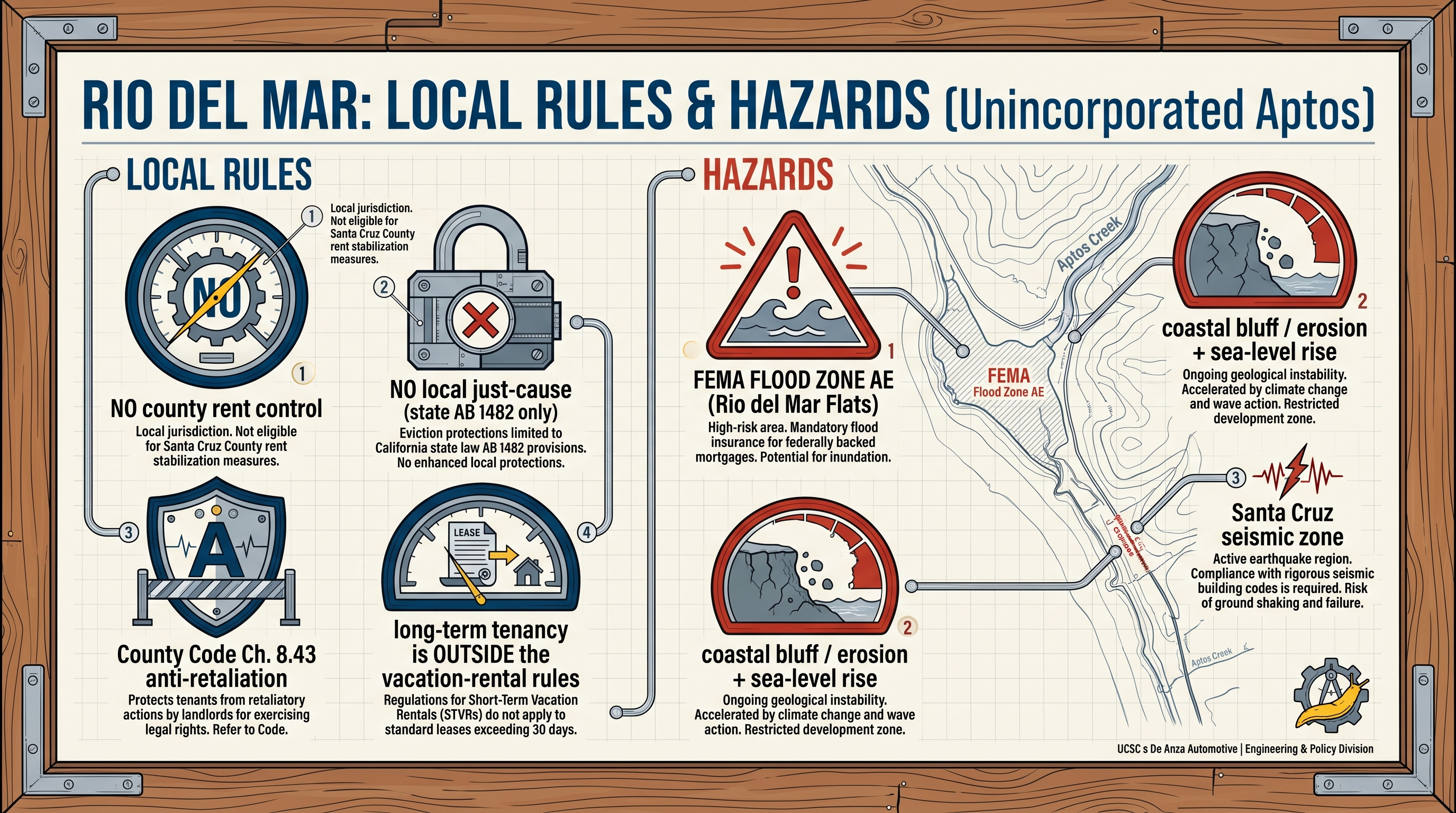
Local rules — unincorporated Santa Cruz County / Rio del Mar
| Question | Answer |
|---|---|
| County rent control / stabilization? | No |
| County just-cause beyond state law? | No (state AB 1482 only) |
| County rental inspection / registration / license (long-term)? | No (STRs excepted; the Ch. 21.06 inspection program is the City, not the county) |
| County anti-retaliation / anti-harassment? | Yes — County Code Ch. 8.43 (Ord. 5410, 2022) |
| STR-conversion tenant safeguard? | Yes — displacing a long-term tenant to create a short-term rental requires paying the tenant 6 months’ rent (2025) |
| Free dispute mediation? | Yes — Conflict Resolution Center, Housing Mediation (voluntary) |
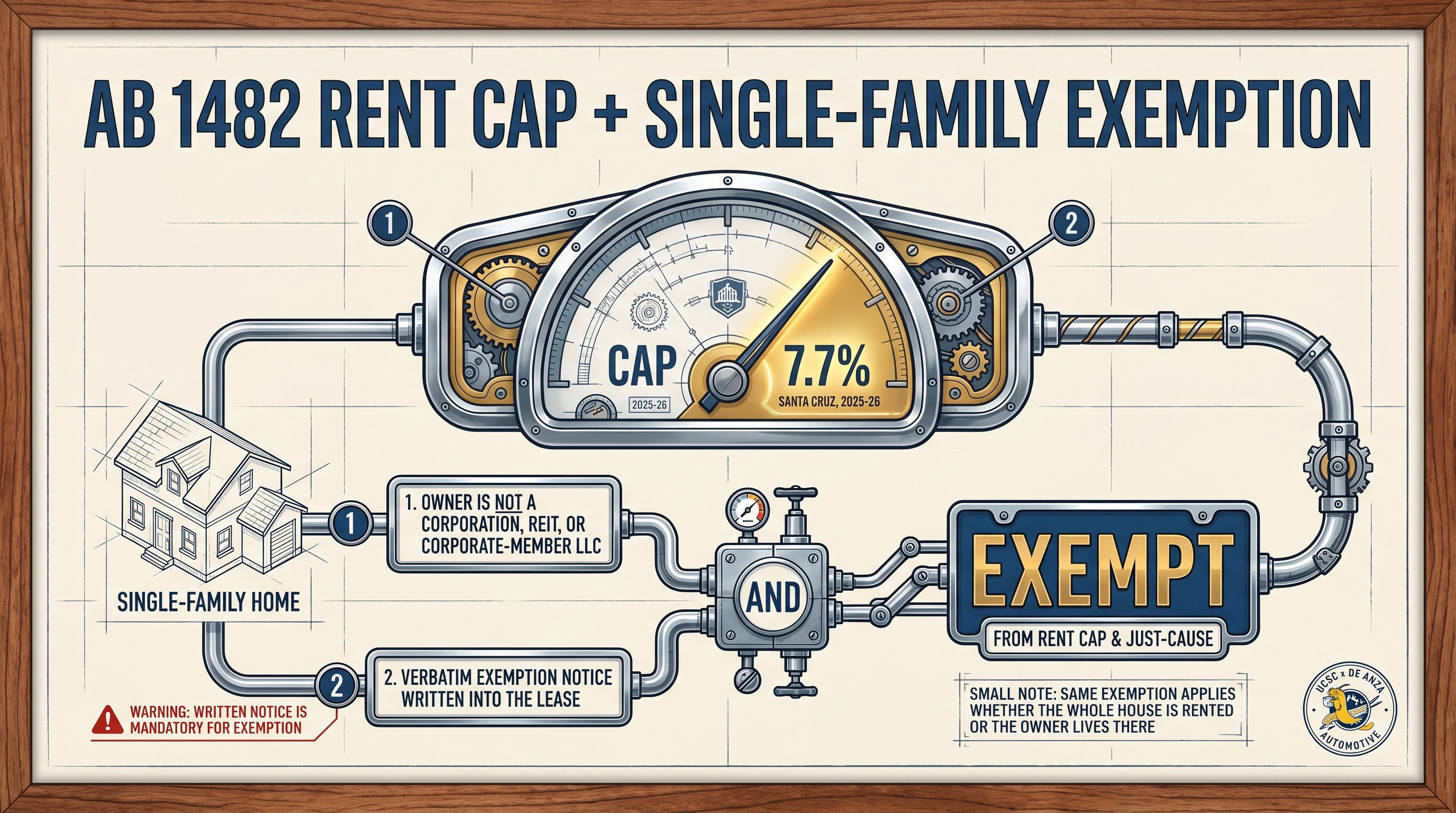
A long-term cohort tenancy is categorically outside the county’s vacation-rental (STR) regime (County Code §13.10.694) — ongoing tenancy to the same renter is explicitly not a “vacation rental.” AB 1482 cap % for Santa Cruz County (grounded): Santa Cruz is not a separately-published BLS metro, so it uses the California statewide (“all other areas”) CPI (calculated by the CA Dept of Industrial Relations) — not the SF-metro 6.3%. For Aug 2025–Jul 2026 that statewide cap is 7.7% (5% + 2.7% CPI), corroborated by the neighboring statewide-CPI counties (Monterey, Santa Clara, Sonoma, Napa, Solano all 7.7%). The Aug 2026–Jul 2027 figure tracks the April 2026 CPI (published mid/late June 2026); confirm the live number via CAA’s “Find Your CPI” tool (caanet.org/ab1482) at lease signing.
California statewide framework
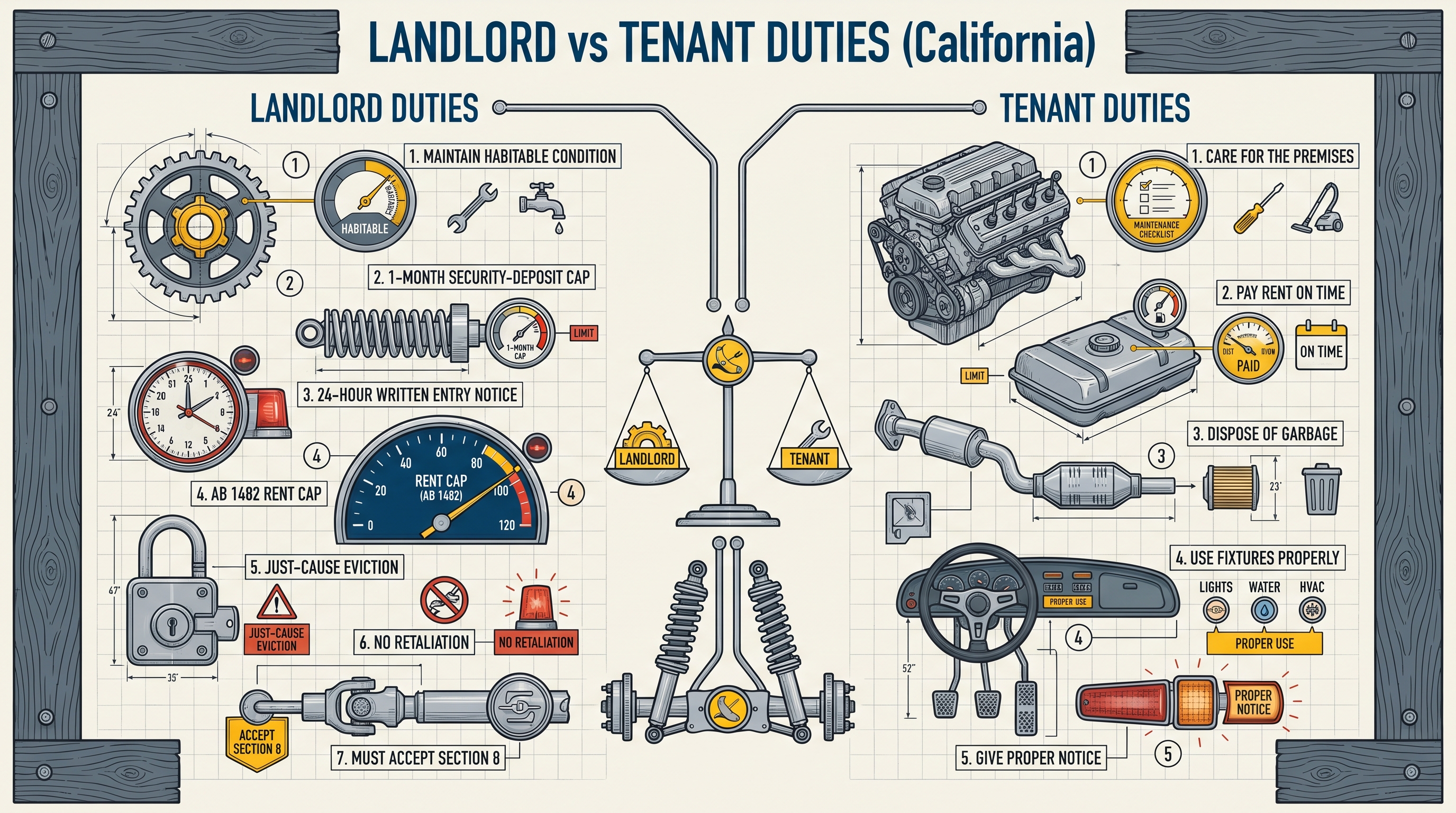
Landlord obligations
| Area | Rule | Code |
|---|---|---|
| Habitability | Keep dwelling fit/repaired; working stove + refrigerator added eff. 2026-01-01 | Civ §1941–1941.1 |
| Security deposit | Cap = 1 month’s rent (eff. 2024-07-01); small-landlord 2-mo exception (natural person, ≤2 properties/≤4 units) | §1950.5 |
| Deposit return | Itemized + balance within 21 days, with receipts/photos | §1950.5(g) |
| Entry | 24-hr written notice, normal business hours, no harassment | §1954 |
| Rent cap (AB 1482) | Lower of 5% + CPI or 10% per 12 mo | §1947.12 |
| Just cause | Required after 12 months; at-fault / no-fault (no-fault relocation = 1 mo rent) | §1946.2 |
| Termination notice | 30 days (<1 yr) / 60 days (≥1 yr) | §1946.1 |
| No self-help eviction | No lockouts/utility shutoffs — penalty $100/day (min $250) | §789.3 |
| No retaliation | 180-day presumption | §1942.5 |
| No discrimination | FEHA + Unruh; must accept Section 8 | Gov §12955 |
Tenant obligations
| Area | Rule | Code |
|---|---|---|
| Care & use | Keep clean/sanitary, dispose of garbage, use fixtures properly, no damage | Civ §1941.2 |
| Tenant-caused damage | Pay for damage from own lack of ordinary care | §1929 |
| Rent | Pay when due | §1947 |
| Notice to vacate | Give notice equal to the rental period (30 days month-to-month) | §1946.1 |
AB 1482 single-family exemption — the key operational item
A single-family home escapes the rent cap and just-cause only if both: (1) the owner is not a REIT, corporation, or corporate-member LLC; and (2) the lease carries the verbatim statutory exemption notice (Civ §1947.12(d)(5) / §1946.2(e)(8)). Without the exact notice, the property is fully rent-capped and just-cause-covered regardless of ownership. Number of unrelated roommates does not change this.
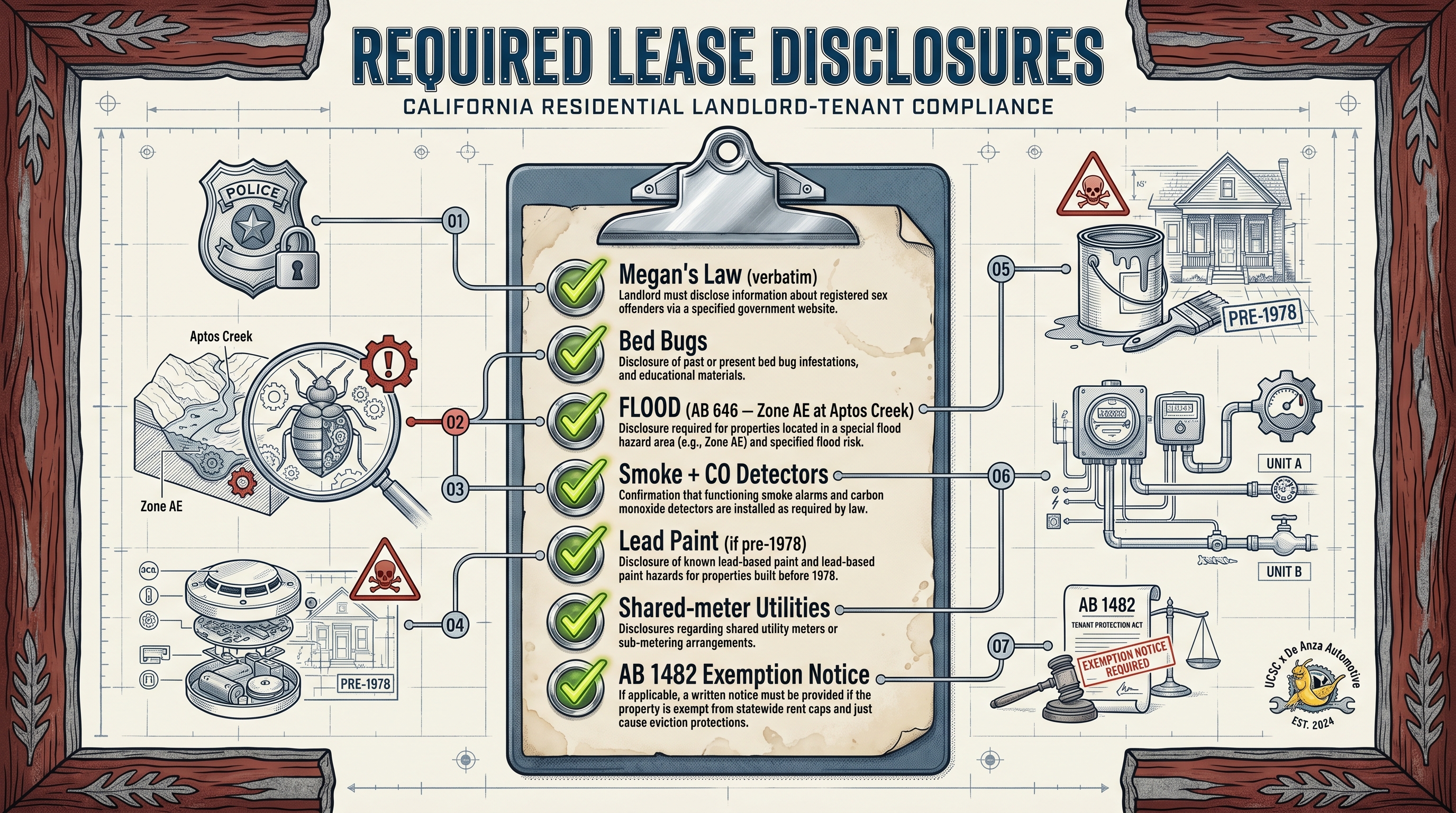
Required lease disclosures
| Disclosure | Trigger | Basis |
|---|---|---|
| Megan’s Law (verbatim) | Always | Civ §2079.10a |
| Bed bugs | Always | Civ §1954.603 |
| Flood hazard (AB 646) | In a flood zone / actual knowledge — applies here | Gov §8589.45 |
| Death on premises (3-yr) | If applicable (HIV/AIDS exempt) | Civ §1710.2 |
| Smoke + CO detectors | Always (CO if gas/garage) | H&S §13113.7 / §17926 |
| Lead-based paint | If built pre-1978 | Federal Title X |
| Shared / sub-metered utilities | Applies (shared master meter) | Civ §1940.9 |
| Mold / pest contract / ordnance / smoking policy | On knowledge / if applicable | Civ §1940.7–.9, §1947.5 |
| AB 1482 exemption notice | If claiming the SFR exemption | Civ §1947.12(d)(5) |
Note: the AB 646 flood disclosure itself tells tenants to obtain renter’s + flood insurance — reinforcing the insurance requirement below.
Co-tenancy — the 4-person cohort
One lease, all four named, with an explicit joint-and-several liability clause. Each tenant is individually liable for 100% of rent and damages — not a 1/4 share — so a departure or non-payment doesn’t leave the landlord short. The cohort’s internal split doesn’t bind the landlord; an overpaying roommate seeks contribution from the others. One security deposit for the whole tenancy. Roommate changes go through a landlord-approved lease amendment (departing tenant stays liable until a written release). Occupancy: California’s “2 per bedroom + 1” easily accommodates 4 in any 2-bedroom-plus home.
Insurance
| Policy | Who | Covers | Excludes |
|---|---|---|---|
| Renter’s (require it) | each tenant | belongings, personal liability, loss-of-use | the building, earthquake, flood |
| DP-3 landlord (Ian must switch to this) | landlord | structure + lost rent | tenant property/liability |
| — | owner-occupied only | claims can be denied once rented out |
A California landlord may lawfully require renter’s insurance (in the lease, uniform, non-discriminatory). Best practice: each tenant carries their own policy, $100k–$300k liability, names the landlord as additional interested party (not additional insured), verified before keys. Ian should move from HO-3 to a DP-3 landlord/dwelling policy (covers structure + lost rent), add liability, and — given the Santa Cruz seismic zone and the Rio del Mar flood zone — consider earthquake (CEA) and flood (NFIP) coverage, both excluded from standard policies.
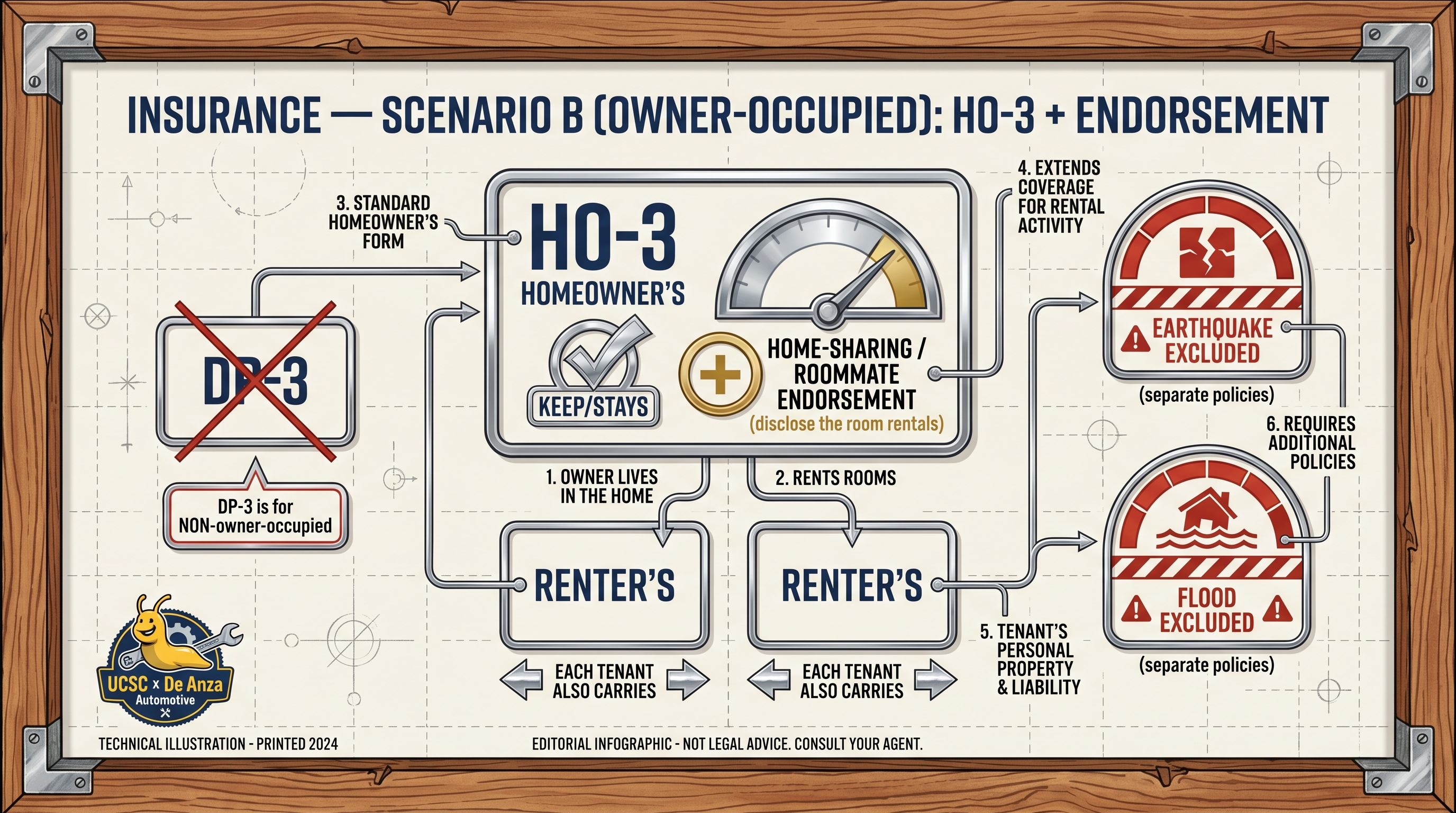
The table above is Scenario A (Ian rents out the whole house). If Ian instead resides there and rents rooms (Scenario B), he keeps HO-3 + a home-sharing endorsement rather than switching to DP-3 — see Tenancy Scenarios - 613 (Whole-House vs Reside-and-Rent-Rooms). Both are shown below.
Rio del Mar location hazards
- Flood: the Rio del Mar “Flats” at the mouth of Aptos Creek are FEMA Zone AE + regulatory floodway (FIRM eff. 2017-09-27; ~44 properties chronically flood; $3.6M FEMA mitigation). Triggers flood disclosure and likely lender-required flood insurance.
- Coastal bluff / erosion + sea-level rise: Seacliff/Rio del Mar/Aptos have the most erosion-at-risk structures in the county; a Local Coastal Program sea-level-rise study is underway (could affect future rebuild rights, not ordinary tenancy).
Action checklist for the lease
- Decide & insert the AB 1482 exemption notice (if Ian is an individual owner) — verbatim.
- One joint-and-several lease, all four named, with a roommate-change clause.
- Disclosure packet: Megan’s Law, bed bugs, flood (AB 646), death-3-yr, smoke/CO, lead (if pre-1978), shared-meter utilities.
- Require renter’s insurance (each tenant, $100k–$300k, landlord as additional interested party).
- Ian: switch HO-3 → DP-3, add liability; price earthquake + flood.
- Security deposit ≤ 1 month’s rent.
Open / verify items
- AB 1482 cap % — grounded (was the one open gap): Santa Cruz uses the California statewide “all other areas” CPI; Aug 2025–Jul 2026 = 7.7%. Remaining: confirm the Aug 2026–Jul 2027 figure (April 2026 CPI) at lease time via CAA’s tool.
- Confirm Ian’s ownership structure qualifies for the SFR exemption, and the exemption-notice wording word-for-word.
- Whether the property is in a lender-mandated flood-insurance area.
- (Tomorrow: homeowner’s→landlord insurance cost; final renter’s-insurance decision; any other landlord/tenant concerns.)
Sources
- CA Civil Code / CCP / Gov Code via leginfo.legislature.ca.gov (§§789.3, 827, 1671, 1929, 1940.7–.9, 1941–1942.5, 1946.1, 1946.2, 1947–1947.12, 1950.5, 1954, 2079.10a, 1954.603, 1710.2; Gov §8589.45, §12955; H&S §13113.7/§17926); CA AG Tenant Protection Act alert; CA DRE tenant guide.
- Santa Cruz County Code Ch. 8.43 (anti-retaliation; Ord. 5410), §13.10.694 (vacation rentals + 2025 update), Ch. 13.20 (Coastal Zone); eCode360 SA4770; BoS ordinance PDFs.
- FEMA Rio del Mar flood ($3.6M grant; Zone AE / Aptos Creek floodway); Conflict Resolution Center housing mediation.
- AB 1482 CPI: CAA “Where are the new CPI figures…” (caanet.org) + CAA “Find Your CPI” (caanet.org/ab1482) — Santa Cruz uses the CA statewide “all other areas” CPI; Aug 2025–Jul 2026 = 7.7%; corroborated by Monterey/Santa Clara/Sonoma/Napa/Solano all 7.7% (bayareamultifamilybroker.com AB 1482 Aug 2025 rates). Verified 2026-06-22.