Landlord-Tenant Rights and Responsibilities (Rio del Mar, Unincorporated Aptos)
Rights and responsibilities for renting a single-family home to Jai’s 4-person cohort at 613, Rio del Mar (unincorporated Aptos, Santa Cruz County). Three layers: California statewide law (the floor), the unincorporated-county local rules, and the lease mechanics (disclosures, co-tenancy, insurance). Not legal advice — have a California landlord-tenant attorney review the final lease packet.
Bottom line for the cohort
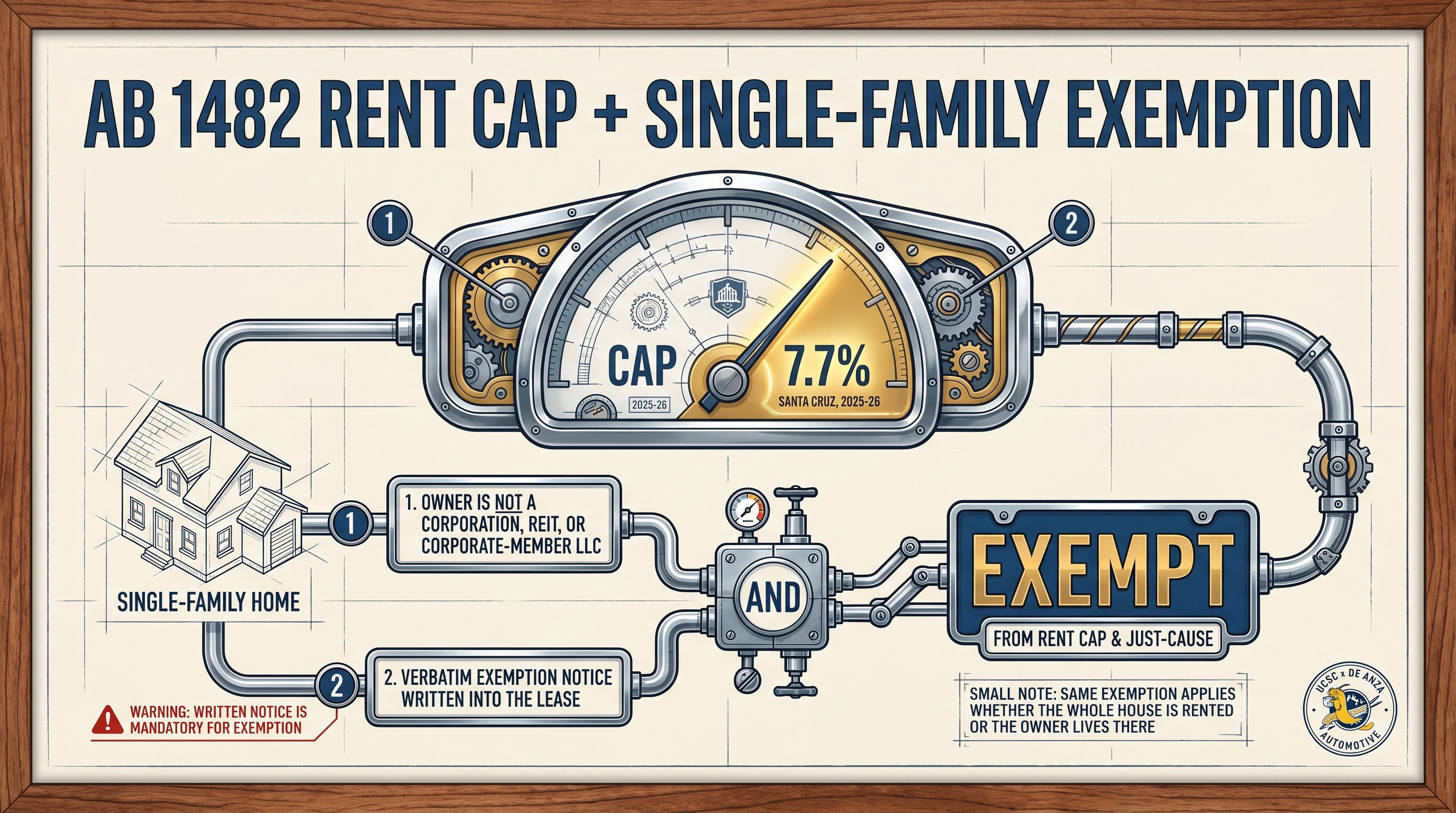
- No local rent control and no local just-cause in unincorporated Santa Cruz County — the only rent cap / just-cause is state AB 1482, and a single-family home escapes even that if the owner is not a corporation and the verbatim exemption notice is in the lease.
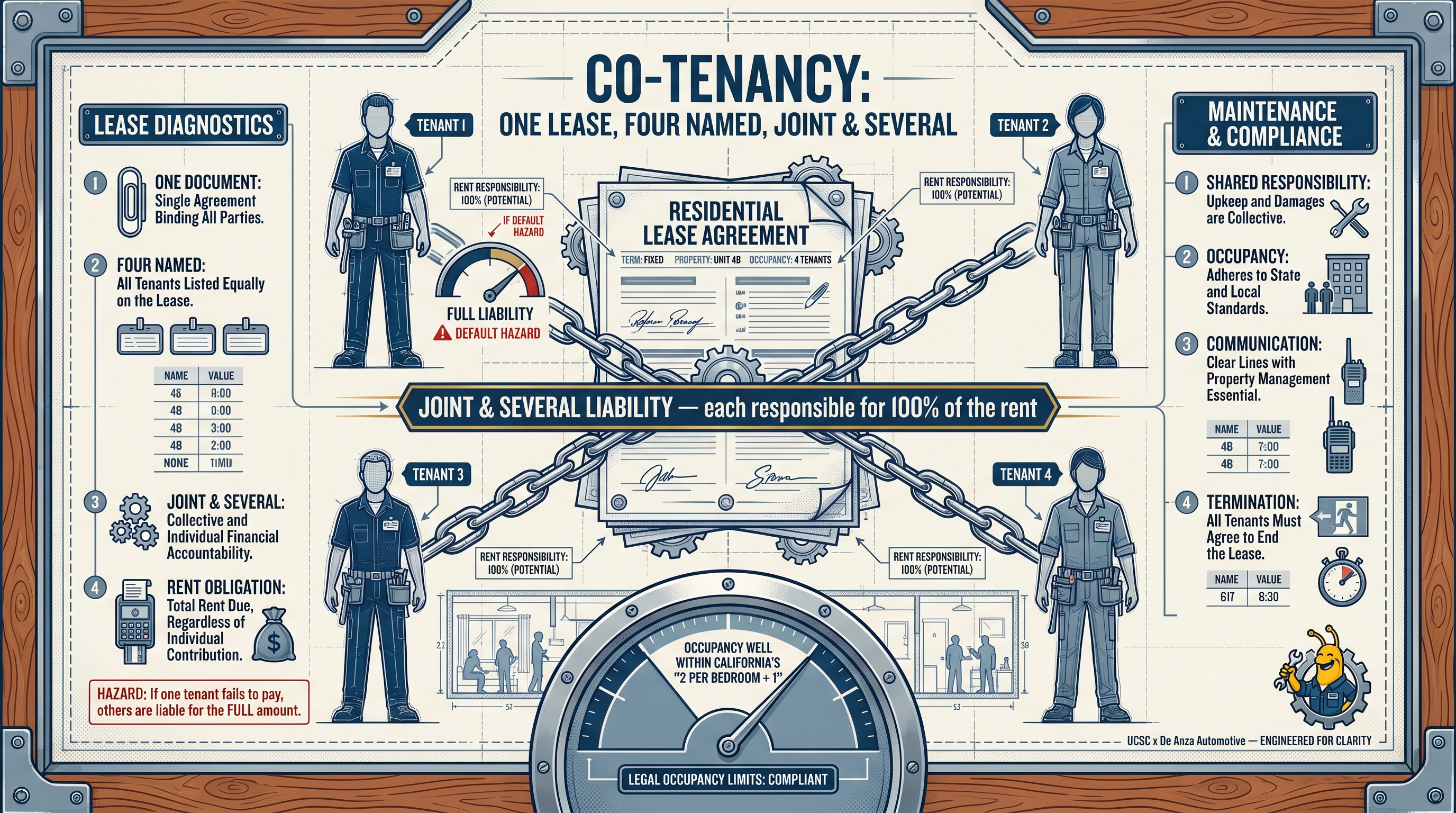
- Structure: one lease, all four named, joint-and-several liability. Occupancy (4 people) is well within California’s “2 per bedroom + 1.”
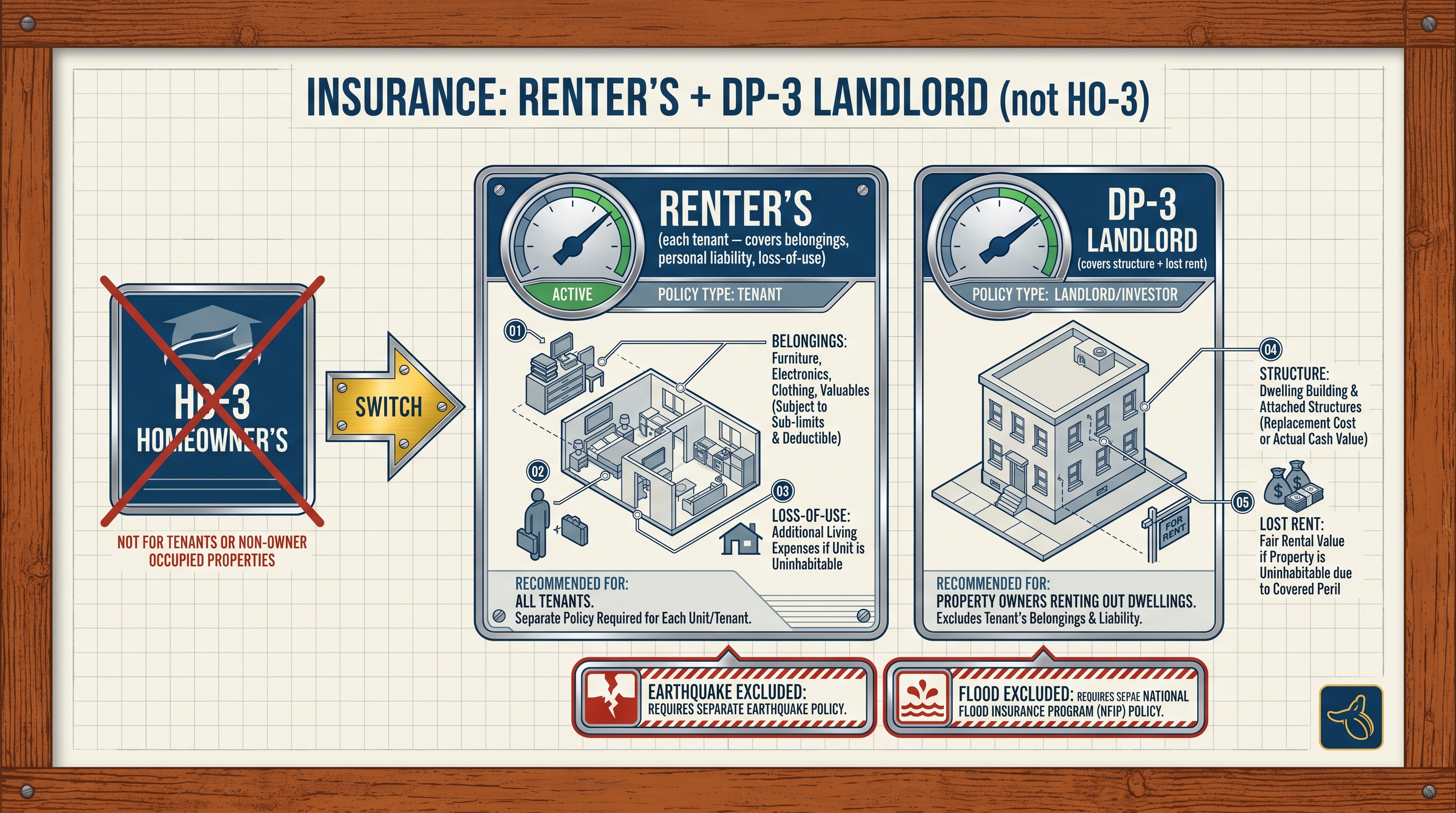
- Require renter’s insurance (lawful, cheap); Ian must switch his own policy from HO-3 to a DP-3 landlord policy.
- Rio del Mar is a FEMA flood zone (AE) at Aptos Creek — flood disclosure is required and flood insurance is likely needed; earthquake is excluded from standard policies (Santa Cruz seismic zone).
Local rules — unincorporated Santa Cruz County / Rio del Mar
| Question | Answer |
|---|
| County rent control / stabilization? | No |
| County just-cause beyond state law? | No (state AB 1482 only) |
| County rental inspection / registration / license (long-term)? | No (STRs excepted; the Ch. 21.06 inspection program is the City, not the county) |
| County anti-retaliation / anti-harassment? | Yes — County Code Ch. 8.43 (Ord. 5410, 2022) |
| STR-conversion tenant safeguard? | Yes — displacing a long-term tenant to create a short-term rental requires paying the tenant 6 months’ rent (2025) |
| Free dispute mediation? | Yes — Conflict Resolution Center, Housing Mediation (voluntary) |
A long-term cohort tenancy is categorically outside the county’s vacation-rental (STR) regime (County Code §13.10.694) — ongoing tenancy to the same renter is explicitly not a “vacation rental.” AB 1482 cap % for Santa Cruz County (grounded): Santa Cruz is not a separately-published BLS metro, so it uses the California statewide (“all other areas”) CPI (calculated by the CA Dept of Industrial Relations) — not the SF-metro 6.3%. For Aug 2025–Jul 2026 that statewide cap is 7.7% (5% + 2.7% CPI), corroborated by the neighboring statewide-CPI counties (Monterey, Santa Clara, Sonoma, Napa, Solano all 7.7%). The Aug 2026–Jul 2027 figure tracks the April 2026 CPI (published mid/late June 2026); confirm the live number via CAA’s “Find Your CPI” tool (caanet.org/ab1482) at lease signing.

California statewide framework
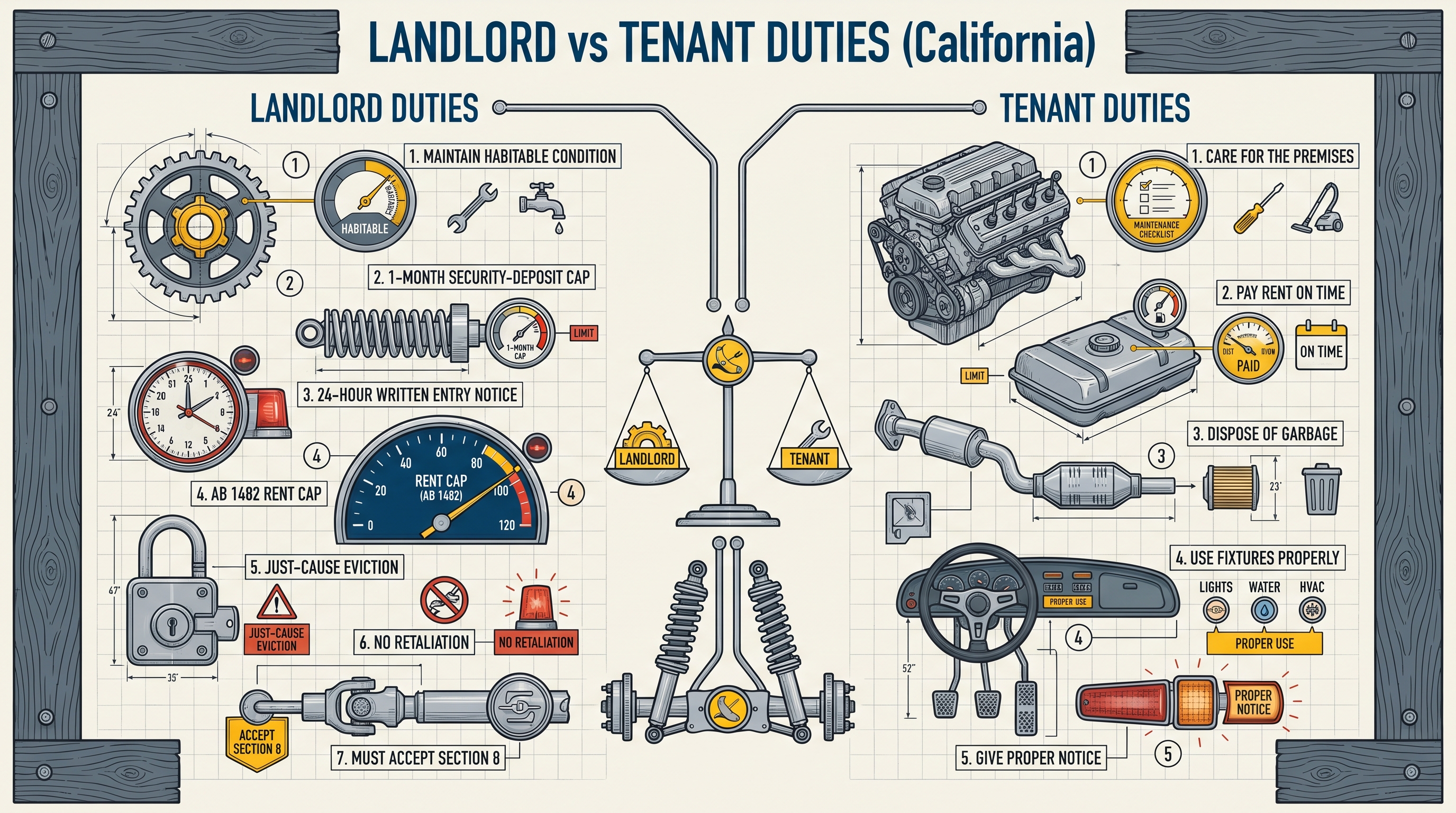
Landlord obligations
| Area | Rule | Code |
|---|
| Habitability | Keep dwelling fit/repaired; working stove + refrigerator added eff. 2026-01-01 | Civ §1941–1941.1 |
| Security deposit | Cap = 1 month’s rent (eff. 2024-07-01); small-landlord 2-mo exception (natural person, ≤2 properties/≤4 units) | §1950.5 |
| Deposit return | Itemized + balance within 21 days, with receipts/photos | §1950.5(g) |
| Entry | 24-hr written notice, normal business hours, no harassment | §1954 |
| Rent cap (AB 1482) | Lower of 5% + CPI or 10% per 12 mo | §1947.12 |
| Just cause | Required after 12 months; at-fault / no-fault (no-fault relocation = 1 mo rent) | §1946.2 |
| Termination notice | 30 days (<1 yr) / 60 days (≥1 yr) | §1946.1 |
| No self-help eviction | No lockouts/utility shutoffs — penalty $100/day (min $250) | §789.3 |
| No retaliation | 180-day presumption | §1942.5 |
| No discrimination | FEHA + Unruh; must accept Section 8 | Gov §12955 |
Tenant obligations
| Area | Rule | Code |
|---|
| Care & use | Keep clean/sanitary, dispose of garbage, use fixtures properly, no damage | Civ §1941.2 |
| Tenant-caused damage | Pay for damage from own lack of ordinary care | §1929 |
| Rent | Pay when due | §1947 |
| Notice to vacate | Give notice equal to the rental period (30 days month-to-month) | §1946.1 |
AB 1482 single-family exemption — the key operational item
A single-family home escapes the rent cap and just-cause only if both: (1) the owner is not a REIT, corporation, or corporate-member LLC; and (2) the lease carries the verbatim statutory exemption notice (Civ §1947.12(d)(5) / §1946.2(e)(8)). Without the exact notice, the property is fully rent-capped and just-cause-covered regardless of ownership. Number of unrelated roommates does not change this.
Required lease disclosures
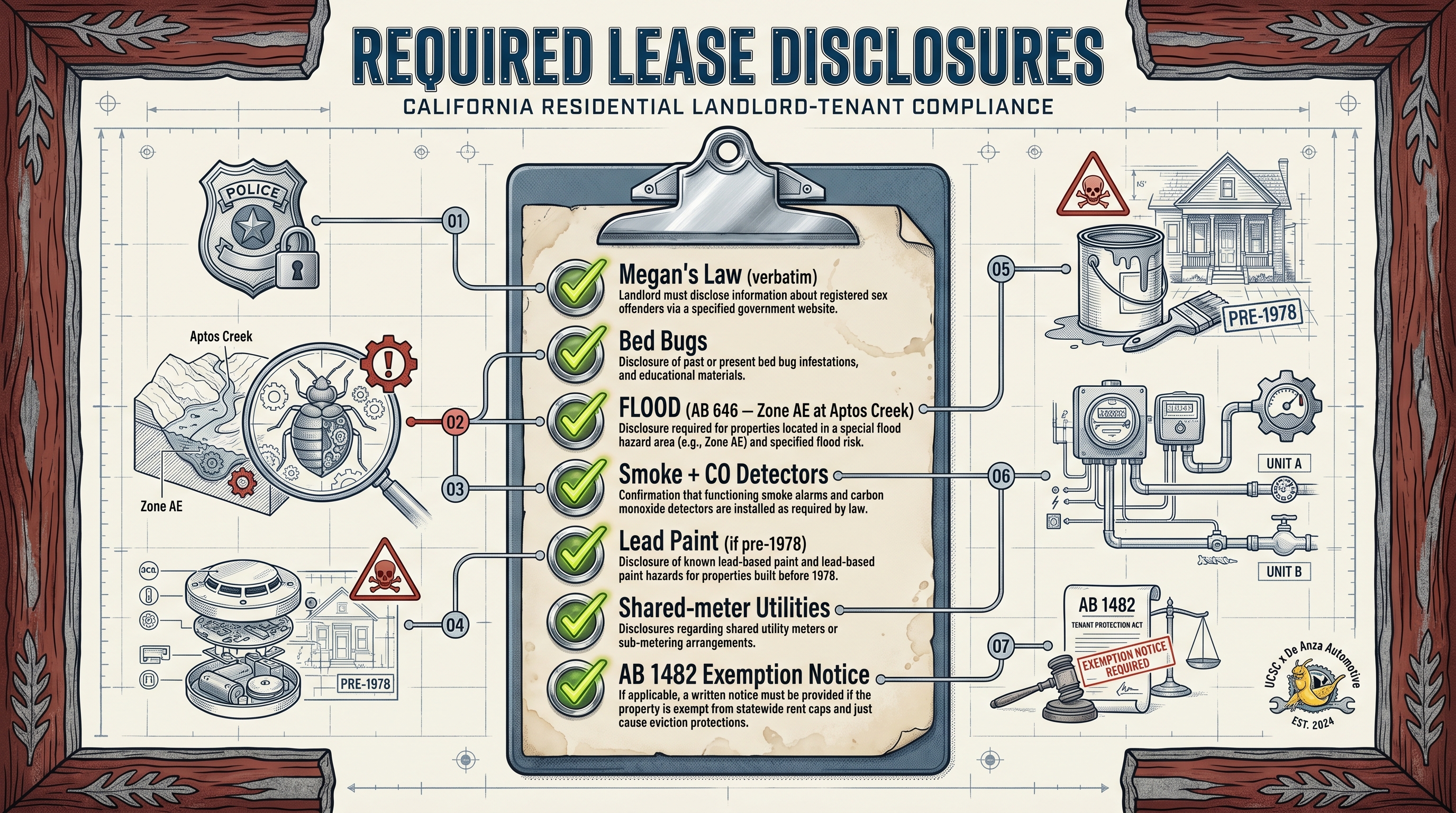
| Disclosure | Trigger | Basis |
|---|
| Megan’s Law (verbatim) | Always | Civ §2079.10a |
| Bed bugs | Always | Civ §1954.603 |
| Flood hazard (AB 646) | In a flood zone / actual knowledge — applies here | Gov §8589.45 |
| Death on premises (3-yr) | If applicable (HIV/AIDS exempt) | Civ §1710.2 |
| Smoke + CO detectors | Always (CO if gas/garage) | H&S §13113.7 / §17926 |
| Lead-based paint | If built pre-1978 | Federal Title X |
| Shared / sub-metered utilities | Applies (shared master meter) | Civ §1940.9 |
| Mold / pest contract / ordnance / smoking policy | On knowledge / if applicable | Civ §1940.7–.9, §1947.5 |
| AB 1482 exemption notice | If claiming the SFR exemption | Civ §1947.12(d)(5) |
Note: the AB 646 flood disclosure itself tells tenants to obtain renter’s + flood insurance — reinforcing the insurance requirement below.
Co-tenancy — the 4-person cohort
One lease, all four named, with an explicit joint-and-several liability clause. Each tenant is individually liable for 100% of rent and damages — not a 1/4 share — so a departure or non-payment doesn’t leave the landlord short. The cohort’s internal split doesn’t bind the landlord; an overpaying roommate seeks contribution from the others. One security deposit for the whole tenancy. Roommate changes go through a landlord-approved lease amendment (departing tenant stays liable until a written release). Occupancy: California’s “2 per bedroom + 1” easily accommodates 4 in any 2-bedroom-plus home.
Insurance
| Policy | Who | Covers | Excludes |
|---|
| Renter’s (require it) | each tenant | belongings, personal liability, loss-of-use | the building, earthquake, flood |
| DP-3 landlord (Ian must switch to this) | landlord | structure + lost rent | tenant property/liability |
HO-3 homeowner’s | — | owner-occupied only | claims can be denied once rented out |
A California landlord may lawfully require renter’s insurance (in the lease, uniform, non-discriminatory). Best practice: each tenant carries their own policy, $100k–$300k liability, names the landlord as additional interested party (not additional insured), verified before keys. Ian should move from HO-3 to a DP-3 landlord/dwelling policy (covers structure + lost rent), add liability, and — given the Santa Cruz seismic zone and the Rio del Mar flood zone — consider earthquake (CEA) and flood (NFIP) coverage, both excluded from standard policies.
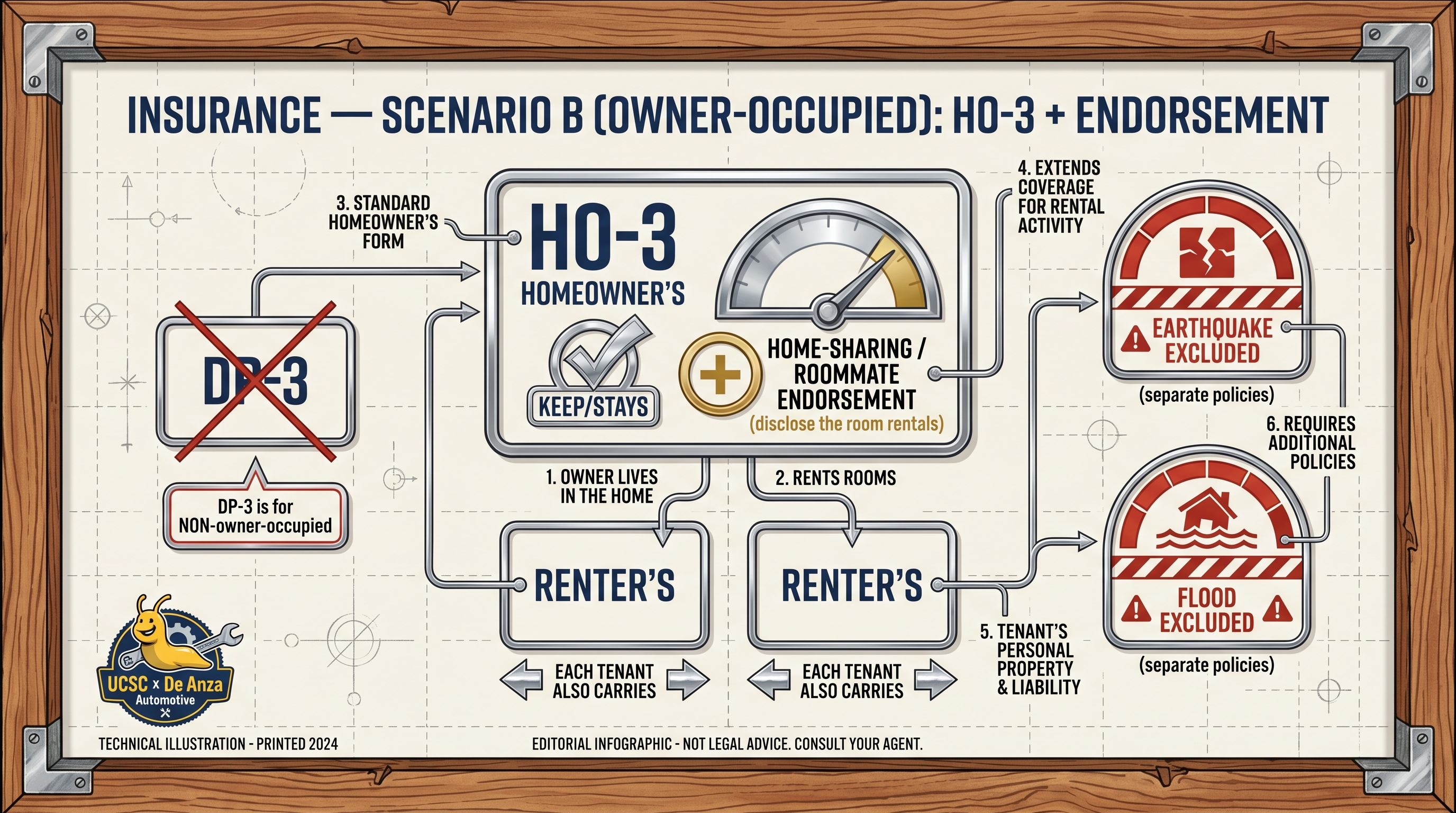
The table above is Scenario A (Ian rents out the whole house). If Ian instead resides there and rents rooms (Scenario B), he keeps HO-3 + a home-sharing endorsement rather than switching to DP-3 — see Tenancy Scenarios - 613 (Whole-House vs Reside-and-Rent-Rooms). Both are shown below.
Rio del Mar location hazards
- Flood: the Rio del Mar “Flats” at the mouth of Aptos Creek are FEMA Zone AE + regulatory floodway (FIRM eff. 2017-09-27; ~44 properties chronically flood; $3.6M FEMA mitigation). Triggers flood disclosure and likely lender-required flood insurance.
- Coastal bluff / erosion + sea-level rise: Seacliff/Rio del Mar/Aptos have the most erosion-at-risk structures in the county; a Local Coastal Program sea-level-rise study is underway (could affect future rebuild rights, not ordinary tenancy).
Action checklist for the lease
- Decide & insert the AB 1482 exemption notice (if Ian is an individual owner) — verbatim.
- One joint-and-several lease, all four named, with a roommate-change clause.
- Disclosure packet: Megan’s Law, bed bugs, flood (AB 646), death-3-yr, smoke/CO, lead (if pre-1978), shared-meter utilities.
- Require renter’s insurance (each tenant, $100k–$300k, landlord as additional interested party).
- Ian: switch HO-3 → DP-3, add liability; price earthquake + flood.
- Security deposit ≤ 1 month’s rent.
Open / verify items
- AB 1482 cap % — grounded (was the one open gap): Santa Cruz uses the California statewide “all other areas” CPI; Aug 2025–Jul 2026 = 7.7%. Remaining: confirm the Aug 2026–Jul 2027 figure (April 2026 CPI) at lease time via CAA’s tool.
- Confirm Ian’s ownership structure qualifies for the SFR exemption, and the exemption-notice wording word-for-word.
- Whether the property is in a lender-mandated flood-insurance area.
- (Tomorrow: homeowner’s→landlord insurance cost; final renter’s-insurance decision; any other landlord/tenant concerns.)
Sources
- CA Civil Code / CCP / Gov Code via leginfo.legislature.ca.gov (§§789.3, 827, 1671, 1929, 1940.7–.9, 1941–1942.5, 1946.1, 1946.2, 1947–1947.12, 1950.5, 1954, 2079.10a, 1954.603, 1710.2; Gov §8589.45, §12955; H&S §13113.7/§17926); CA AG Tenant Protection Act alert; CA DRE tenant guide.
- Santa Cruz County Code Ch. 8.43 (anti-retaliation; Ord. 5410), §13.10.694 (vacation rentals + 2025 update), Ch. 13.20 (Coastal Zone); eCode360 SA4770; BoS ordinance PDFs.
- FEMA Rio del Mar flood ($3.6M grant; Zone AE / Aptos Creek floodway); Conflict Resolution Center housing mediation.
- AB 1482 CPI: CAA “Where are the new CPI figures…” (caanet.org) + CAA “Find Your CPI” (caanet.org/ab1482) — Santa Cruz uses the CA statewide “all other areas” CPI; Aug 2025–Jul 2026 = 7.7%; corroborated by Monterey/Santa Clara/Sonoma/Napa/Solano all 7.7% (bayareamultifamilybroker.com AB 1482 Aug 2025 rates). Verified 2026-06-22.
Tenancy Scenarios - 613 (Whole-House vs Reside-and-Rent-Rooms)
Two ways to house Jai’s 4-person cohort at 613, analyzed side by side. Not legal/tax advice — confirm insurance with your carrier and the lease packet with a CA landlord-tenant attorney.
- Scenario A — Whole-house rental (Ian off-site): Ian rents the entire dwelling to the cohort and does not live there. Arms-length landlord–tenant. (This is the prior analysis.)
- Scenario B — Reside & rent rooms (owner-occupied): Ian lives in the home and rents rooms to the cohort members (housemates). Owner-occupant + resident-landlord.
Side-by-side
| Dimension | A — Whole-house, off-site | B — Reside & rent rooms |
|---|
| Relationship | Arms-length landlord–tenant | Owner-occupant + resident-landlord (housemates) |
| Residents / cohort share | 4 of 4.25 ≈ 94.1% | 4 of 5 ≈ 80% (you full-time; you consume ~20%) |
| Your insurance | DP-3 landlord policy (switch off HO-3 — HO-3 claims can be denied when not owner-occupied) | HO-3 homeowner’s stays — but disclose the room rentals + add a home-sharing/roommate endorsement; DP-3 is not right when you live there |
| Cohort utilities (all-in) | ≈ $533/mo (94.1% of master) | ≈ $489/mo (cohort shares the fixed service charges with you) |
| Your personal utilities | $0 — fully recovered via rent | ≈ $122/mo (your ~20% of fixed + your own usage) |
| Lease form | One joint-&-several lease for the dwelling | Room/housemate agreement(s); you’re a resident party — set house rules + common-area terms |
| AB 1482 | SFR exemption (non-corp owner + verbatim notice) | Same standard SFR exemption (non-corp + verbatim notice). Owner-occupied ≤2-bedroom exemption N/A — cohort occupies 3 bedrooms (> 2). “Owner move-in” just-cause moot |
| Single-lodger shortcut (§1946.5) | N/A | Does NOT apply — that’s for one lodger; with four it’s full landlord-tenant + unlawful-detainer |
| Entry / privacy | Landlord entry rules (24-hr notice) | You’re a co-resident; shared common areas; less privacy, more day-to-day control |
| Tax (flag, not advice) | Full rental property (income, depreciation, expenses) | Partial rental of your primary home (rented-room %); possible partial impact on the capital-gains primary-residence exclusion; keeps primary-residence status |
| Control vs privacy | More privacy, less day-to-day oversight | More oversight, less privacy; you wear landlord + housemate hats |
Cost detail
The cohort is the same 4 people in both scenarios, so their variable usage (PG&E, water volumetric ≈ $254 master) is essentially unchanged. The difference is the fixed service charges (Greenwaste $115.77 + AT&T $95.95 + water service $100.92 = $312.64/mo), which are per-property:
- A: cohort carries 94.1% of everything → ≈ $533/mo all-in; you recover it in rent.
- B: you absorb ~20% of the fixed charges (and your own usage), so the cohort’s share drops to ≈ $489/mo (they save ~$44/mo), and you carry ≈ $122/mo of household utilities personally. The master bill is larger in B (you’re a fifth resident).
So the cohort pays modestly less in B; the real trade is privacy + tax simplicity (A) vs control + a homeowner’s-policy + shared costs (B).
Common to both scenarios
These don’t change between A and B:
- No local rent control / no local just-cause (unincorporated Santa Cruz County — state AB 1482 only); County Ch. 8.43 anti-retaliation applies.
- Habitability, security-deposit cap (1 month), 21-day return, required disclosures (Megan’s Law, bed bugs, flood/AB 646, smoke/CO, lead if pre-1978, shared-meter utilities).
- Require renter’s insurance from the cohort either way.
- Rio del Mar hazards — FEMA flood Zone AE at Aptos Creek (flood disclosure + likely flood insurance), coastal/seismic exposure.
- The AB 1482 single-family exemption needs the verbatim notice in the lease in both.
Recommendation lens
- Choose A if you value privacy, a clean full-rental tax treatment, and not co-living. It maximizes recovered rent (~$533/mo utilities included) but you switch to a DP-3 landlord policy and have less day-to-day oversight.
- Choose B if you want to live there / keep oversight and your homeowner’s policy in place (with an endorsement). The cohort pays a bit less; you take on ~$122/mo of personal utilities, less privacy, and a partial-rental tax picture.
Key assumptions & verify items
- Scenario B occupancy CONFIRMED: 5 total (4 cohort + you full-time) → cohort 80%.
- Bedrooms CONFIRMED: cohort occupies 3. Owner-occupied ≤2-bedroom AB 1482 exemption is N/A (3 > 2); the standard SFR exemption (non-corp + verbatim notice) is the route in both scenarios. Occupancy (4 in 3 bedrooms) is well within “2 per bedroom + 1.”
- Insurance is carrier-specific — confirm HO-3-with-endorsement (B) vs DP-3 (A) with your insurer; both exclude earthquake + flood (separate policies).
- Cost figures are estimates layered on the grounded master bills + the actual SqCWD/PG&E data; they firm up at real occupancy.
Sources
Utility Cost Allocation in Leases (PG&E 613)
Recurring monthly services for unit 613 (settling Jai’s cohort), and how to size them for a lease. Decision (2026-06-22): all four services are included in rent.
Defining facts (2026-06-22): 613 has no separate meter — electric, gas, or water — so it draws on the property’s shared master meters, and the PG&E account below is the whole-property bill. Jai’s cohort will be 4 of 4.25 residents = 94.1%, which sets the allocation key. This largely resolves the inclusion shape: a shared master meter makes Passthrough impossible (can’t hand a master account to the cohort) and Submeter an impractical install (especially gas/water); and “included = flat” rules out variable RUBS billing. So the live choice narrows to Flat-include the cohort’s 94.1% share (optionally Flat + cap), using the RUBS ratio only as the basis for that flat figure.
PG&E figures are grounded in account (account on file) “Bill Charges” (24 monthly bills, Jul 2024–Jun 2026, extracted 2026-06-22 from myaccount.pge.com); the water figure is grounded in the property’s own SqCWD bill ($127.37/mo, 5/8” meter, at the current 1.75 residents) plus Jai’s household usage for the occupancy projection; rate tiers are grounded in PG&E and Soquel Creek Water District primary tariff documents (see Sources).
Monthly services bundle (all included in rent)
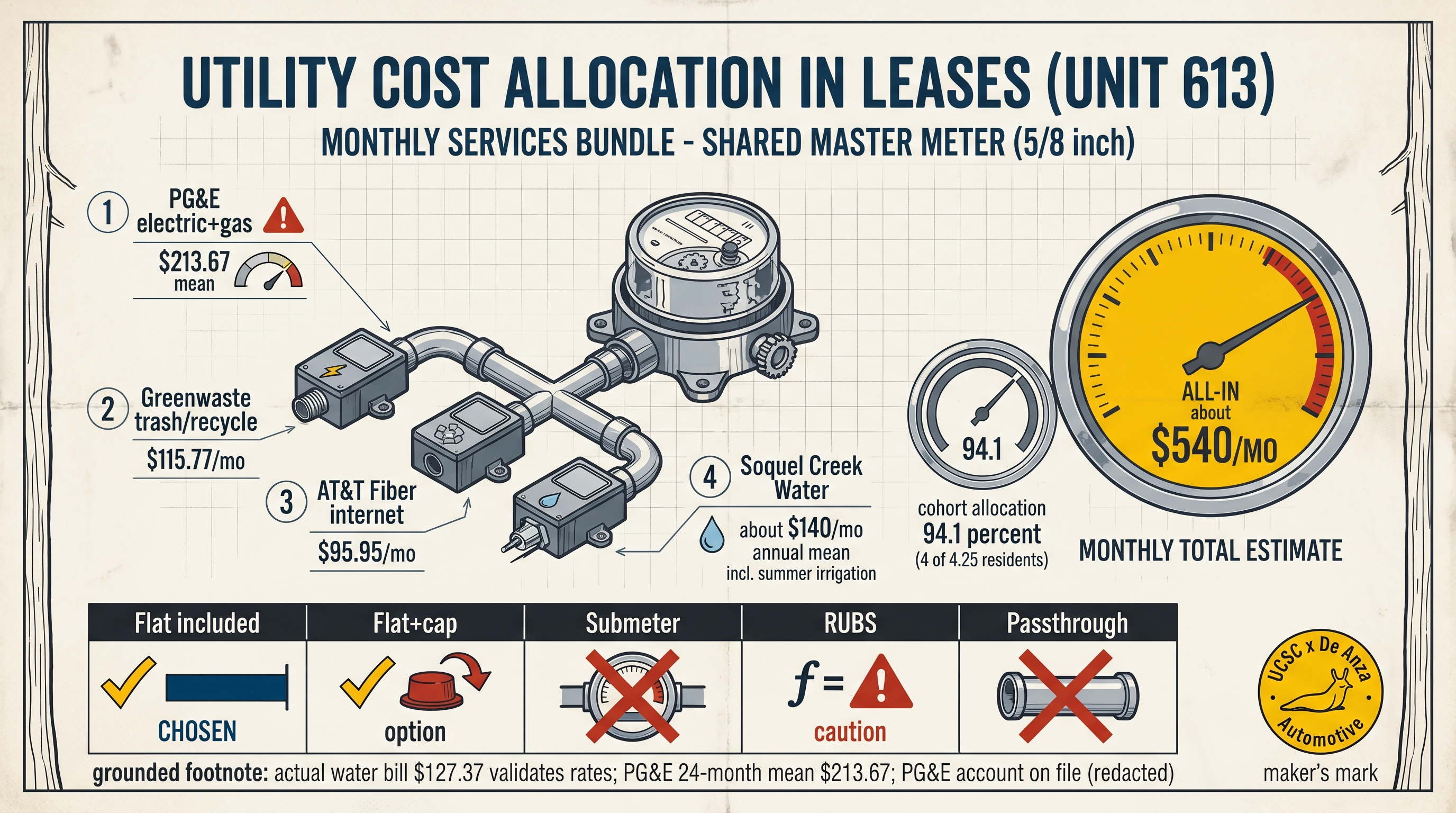
All figures are on the shared master meter, allocated to the cohort by its 94.1% headcount share (4 of 4.25 residents).
| Service | Master bill (whole property) | Cohort share (94.1%) | Type | Handling |
|---|
| PG&E (electric + gas) | $213.67 mean | ≈ $201/mo | Variable (right-skewed) | flat-include the share |
| Greenwaste (trash/recycle/compost) | $115.77 | $108.96 | Fixed | flat-include the share |
| AT&T Fiber internet | $95.95 | $90.31 | Fixed | flat-include the share |
| Soquel Creek Water | ≈ $150 (5/8” meter, annual mean) | ≈ $140/mo est. | Variable (tiered, seasonal) | flat-include the share |
| All-in monthly | ≈ $574 | ≈ $540/mo | | |
Allocation basis: the cohort is 4 of 4.25 residents (94.1%), so each master bill is allocated at 94.1% — and since the cohort is ~94% of the household, a flat-included figure recovers nearly the whole master bill through their rent, with the landlord bearing the variance. Greenwaste and AT&T are flat (no swing, no moral hazard); PG&E and water are variable, right-skewed, and moral-hazard-exposed — water’s tiers actively penalize overuse (Tier 3 $20.35/unit, about 77% above Tier 1), and summer irrigation raises that exposure. The water meter size is now confirmed 5/8” (fixed $100.92): an actual SqCWD bill reads $127.37 for one month at the property’s current 1.75 residents — exactly $100.92 + 2.3 units × $11.50, validating the rates with no surcharges. The water figure above is the annual mean at the future 4.25 residents including light summer irrigation (see Appendix B), and is the one line that still moves with realized usage.
Visual
PG&E — the grounded values (24-month actuals)
| Statistic | Value |
|---|
| Mean (24-mo) | $213.67 |
| Median | $180.12 |
| Min month | $69.59 (Oct 2025) |
| Max month | $390.81 (Feb 2025) |
| Std dev (population) | ≈ $100.35 |
| Range swing | 5.6× |
| Total (24 mo) | $5,128.02 |
Quartiles (linear interpolation): Q1 $133.40 · Q2 $180.12 · Q3 $307.95 · IQR $174.56. The distribution is right-skewed (winter Dec–Mar $276–$391; spring/fall lows $70–$135), so the mean sits above the median.
Which 12 months — trailing 12 (Jul ‘25–Jun ‘26): total $2,325.44, ÷12 = $193.79 (current rate structure). Prior 12: $2,802.58, ÷12 = $233.55 (about $40/mo higher, pre-March-2026 rates).
The five allocation structures (PG&E and water)
These apply to the variable services — PG&E and water; the flat services (Greenwaste, AT&T) are simply included at cost. Because 613 is on a shared master meter, #3 and #5 are off the table and #4 conflicts with flat inclusion — leaving #1 Flat (recommended) or #2 Flat + cap, sized at the 94.1% share. Each row answers: who absorbs the variance, the rate inflation, and the moral-hazard load?
| # | Structure | Monthly figure | Bears variance | Bears inflation | Conservation incentive | Viability for 613 |
|---|
| 1 | Flat included | ≈ 94.1% share, flat in rent | Landlord (all) | Landlord | None | ✅ recommended |
| 2 | Flat + cap / billback | share incl., bill extreme overage | Landlord, to cap | Shared above cap | Partial | ✅ hedge option |
| 3 | Submeter | Tenant pays actual | Tenant | Tenant | Full | ✗ no meter — impractical install |
| 4 | RUBS (formula) | Tenant pays % of master | Tenant (share) | Tenant | Partial | ⚠ basis only — variable billing ≠ “included” |
| 5 | Passthrough | $0 to landlord | Tenant | Tenant | Full | ✗ can’t transfer a master account |
When PG&E is included in rent, the landlord pays every dollar of the real bill over the year, so the figure to recover is annual total ÷ 12 = the mean. On right-skewed data the median under-recovers: charging the median ($180/mo) collects about $2,161/yr but pays about $2,564/yr — the landlord eats about $400/yr. The same mean-not-median logic applies to water once 613’s usage is known — its tiered structure makes the high-usage tail even steeper.
Recommendation — flat-include the cohort’s 94.1% share
Bake the cohort’s 94.1% share of the master bills into flat rent: about $540/month all-in — PG&E ≈ $201 (24-mo mean) + Greenwaste $108.96 + AT&T $90.31 + Water ≈ $140 (annual mean incl. light summer irrigation). At the buffered ~$200 PG&E figure it is about $527/mo.
Why flat, not RUBS billing: 613’s shared master meter rules out Passthrough and makes Submeter an impractical install, and “included in rent” means a fixed figure — so the RUBS 94.1% ratio serves only as the basis for the flat amount, not as ongoing variable billing.
Consider Flat + cap for the variable lines (PG&E, water): the actual water bill ($127.37) is at the property’s current 1.75 residents, so the whole-property bills will rise as the cohort fills it to 4.25 — and water peaks across the Jun–Oct irrigation season — meaning history understates the future. A cap with billback on extreme overage (or a first-year true-up) limits the landlord’s downside. The meter size is now confirmed (5/8”), so the prior $658 ceiling is off the table; the remaining variable is realized usage/season.
Appendix A — PG&E rate tiers for Aptos (Baseline Territory T) · grounded
Grounded — sources: PG&E tariff PDFs (E-1, E-TOU-C, G-1) + baseline & Base Services Charge pages, retrieved & verified 2026-06-22 (see Sources).
Aptos is in PG&E Baseline Territory T (coastal Santa Cruz). Default residential plan = E-TOU-C (time-of-use, Peak 4–9pm every day); legacy tiered E-1 available by election.
E-1 tiered (eff 2026-06-01): Tier 1 (0–100% baseline) $0.32561/kWh; Tier 2 (over baseline) $0.40702/kWh.
E-TOU-C (eff 2026-06-01): Summer (Jun–Sep) Peak $0.52240 / Off-Peak $0.39940; Winter (Oct–May) Peak $0.39757 / Off-Peak $0.36757; baseline credit −$0.08140/kWh.
Baseline allowance — Territory T (kWh/day): Basic (gas+electric) 6.5 summer / 7.5 winter; All-Electric 7.1 / 12.9.
Base Services Charge (income-graduated fixed charge, NEW eff 2026-03-01): Tier 1 (CARE) about $6/mo · Tier 2 (FERA) about $12/mo · Tier 3 (default) about $24.12/mo ($0.79343/day).
Gas G-1 (eff 2026-06-01): Baseline $2.38935/therm, Excess $2.89247/therm — gas service to this specific premise unconfirmed.
Caveat: much of Santa Cruz County uses Central Coast Community Energy (3CE) for generation with PG&E delivery; if 613’s account is on 3CE, the generation component is replaced by 3CE + PCIA and totals differ. Rates change about quarterly; re-verify after Sep 2026.
Appendix B — Soquel Creek Water District tiers (anticipated) · grounded
Grounded — sources: Soquel Creek Water District 2026 Rates Schedule, Rates & Fees, 2023 Rate Study, retrieved & verified 2026-06-22 (see Sources).
SqCWD serves Aptos. Billing is monthly; billing unit = 748 gallons (1 HCF). Current rates eff 2026-01-01.
Volumetric tiers (single-family, per 748-gal unit, monthly): Tier 1 (0–3.99 units) $11.50 · Tier 2 (4–7.99) $12.90 · Tier 3 (8+) $20.35.
Fixed monthly service charge: standard 5/8” residential meter $100.92/mo (restricted 5/8” for under-640-sq-ft dwelling $56.13; 1” $235.27). The fixed charge dominates a typical low-usage bill.
Increases: +12% Jan 2025, +12% Jan 2026 (current), +12% scheduled Jan 2027. No drought surcharge currently billed (district may impose Stage 0–5 emergency rates by board action).
Estimate for 613 — grounded in the property’s actual bill. A current SqCWD bill: $127.37 for one month at the property’s current 1.75 residents = $100.92 fixed (confirms 5/8” meter) + 2.3 units × $11.50 (Tier 1). This validates the rates exactly, with no surcharges, and gives a real per-capita of 1.3 units/person.
Projecting to the future 4.25 residents: indoor base ≈ 3.5–5.6 units (low end = the cohort’s own ~0.8 units/person from Jai’s household; high end = this property’s current 1.3 units/person), i.e. master ≈ $141–167 → cohort 94.1% ≈ $133–158. Adding light summer irrigation (rest of June through ~October; “not much, but some” — modest Tier-2 spillover those ~5 months) lifts the annual mean to roughly $150 master → $140/mo cohort. The fixed $100.92 is locked; only the volumetric/seasonal portion moves.
Open questions
- Flat vs Flat + cap for the variable lines (PG&E, water) — the only remaining shape choice. (Resolved: shared master meter — confirmed 5/8” — rules out submeter/passthrough; “included = flat” rules out RUBS billing.)
- Realized water usage at full 4.25 occupancy + summer irrigation — the actual bill ($127.37) is at the current 1.75 residents; the ~$140/mo annual-mean water figure firms up after a few months at full occupancy, especially across the Jun–Oct irrigation season. Argues for Flat + cap or a first-year true-up.
Sources
- PG&E tariffs: pge.com/tariffs/assets/pdf/tariffbook/ ELEC_SCHEDS_E-1.pdf · ELEC_SCHEDS_E-TOU-C.pdf · GAS_SCHEDS_G-1.pdf; pge.com baseline-allowance + base-services-charge pages.
- Soquel Creek Water District: soquelcreekwater.org/DocumentCenter/View/2726 (2026 Rates Schedule) · /166/Rates-Fees · /DocumentCenter/View/2400 (2023 Rate Study).
- PG&E account (account on file), “Bill Charges” history, myaccount.pge.com, extracted 2026-06-22 (the 24-month grounded values).
- Greenwaste $115.77/mo and AT&T Fiber $95.95/mo — provided by Ian, 2026-06-22.
- 613 occupancy = 4 of 4.25 residents; 613 has no separate electric/gas/water meter (shared master) — provided by Ian, 2026-06-22.
- Actual SqCWD bill: $127.37 for one month, 5/8” meter, 2.3 units, at the property’s current 1.75 residents (no surcharges) — provided by Ian, 2026-06-22.
- Water-usage bases: Jai’s current 5-person household ≈ 3,000 gal/mo; light irrigation expected rest-of-June through ~October — provided by Ian, 2026-06-22.